

A LITTLE BOX FULL OF BIG SOUNDS
Cigar box guitar history opens with trash-to-treasure idea in mid-1800s


EXCELSIOR SPRINGS – A full-bodied moonshiner huffs and puffs into the corn liquor jug resting on the crook of his right arm to create a throaty, wolfing sound.
A sallow-eyed man, coal dust under his nails, rakes calloused fingers over a zincridged washboard.
Between them stands a wiry, hardscrabble, Rip Van Winkle-style character with a belly-length gray beard and blue jean coveralls. He strums taut strings over the face of a cigar box, making them vibrate with grit and sass.
Together, they create music as sweet as black cherry wine on a moon-bright autumn night.
The Blue Mountains music image fits a trio centered by a man playing a cigar box guitar – an instrument representing musical Americana, musical history and musical now in any setting.
The instrument’s appeal reaches a broader audience than one tucked away in America’s Appalachian backwoods.
“These things were used more than just in your usual hillbilly setup,” Shane Speal said. “It encompasses blues, it encompasses bluegrass, Tin Pan Alley and there was a vaudeville tradition.”
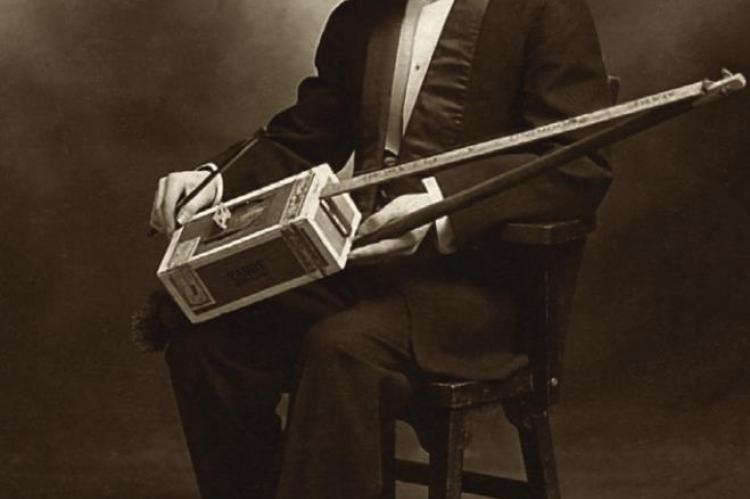
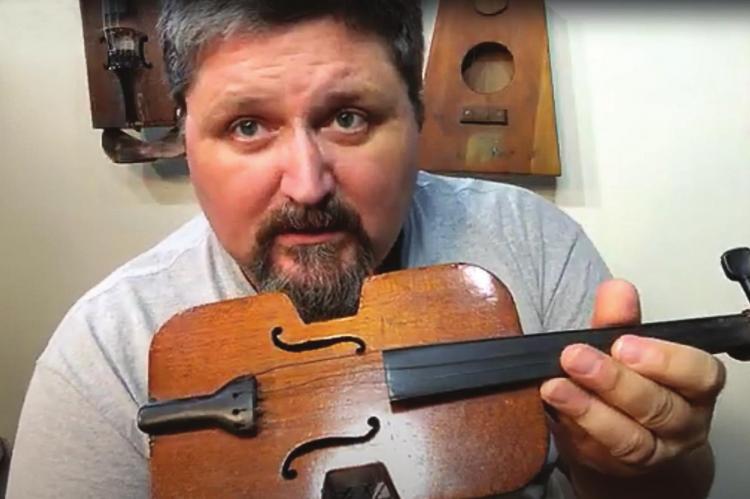
While doing a vaudeville act, The Three Stooges’ wild-haired Larry Fine would play a one-string, cigar box cello, Speal said. As the curator of the Cigar Box Museum in New Alexandria, Pennsylvania, he is a cigar box guitar historian, collector and maker.
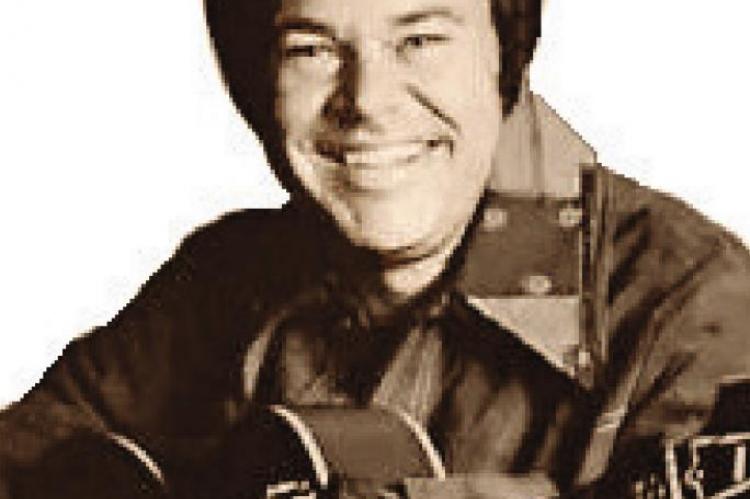
The instrument over the past nine score generations has earned a position in the hands of musicians representing the full scale of musical traditions. Notable box players have included eight-time Grammy-winning jazz and R&B musician George Benson, country music’s Roy Clark and rock music legend Jimi Hendrix, who learned to play using homemade cigar box guitars.
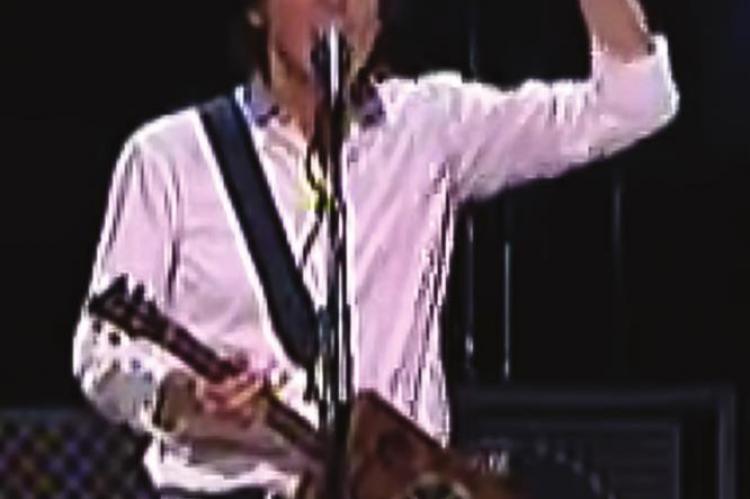
The boxes continue to make history as part of today’s music scene, Speal said. Paul McCartney, along with surviving Nirvana members Dave Grohl and Krist Novoselic, won the 2014 Grammy for Best Rock Song, “Cut Me Some Slack,” with McCartney front and center playing a box, Speal said.
“McCartney played a cigar box guitar made by a friend of mine in North Hollywood, California,” Speal said. “It was Johnny Depp that bought the guitar for McCartney.”
A POOR MAN’S INSTRUMENT
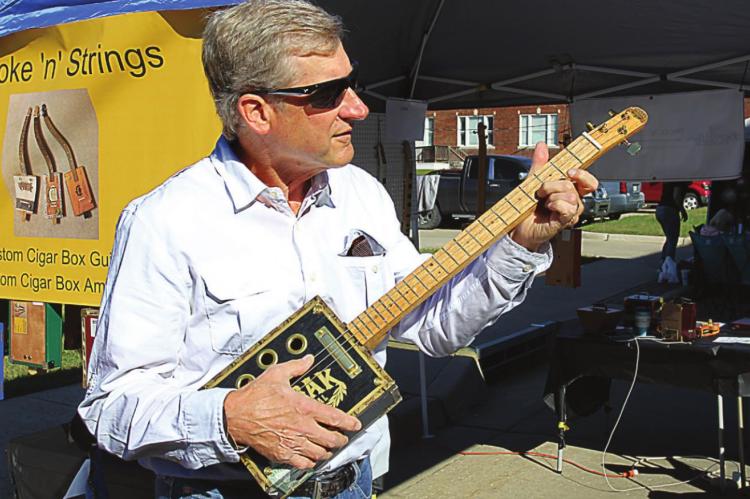
“They’ve been making these since the 1800s, but there’s been a resurgence in recent years,” Brent Kasl said while standing under the blue awning where he sold cigar box guitars during the Excelsior Springs Oktoberfest.
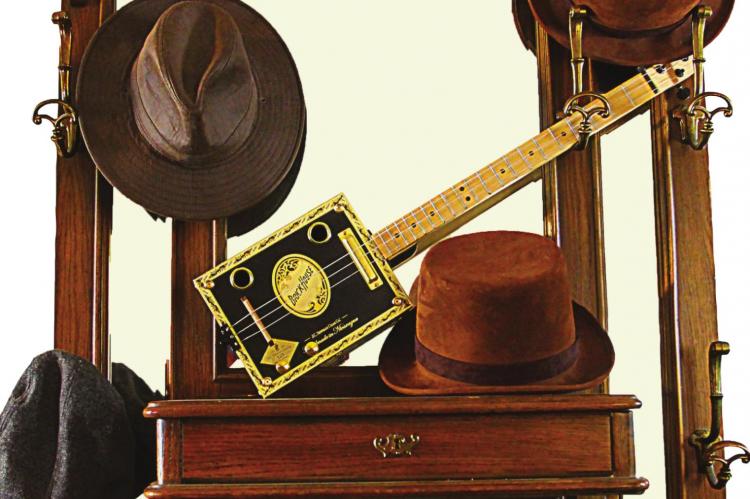
The rectangular body is an actual cigar box – something a poor man or even a slave in the 1840s might latch onto after a rich man had finished the prized smokes inside. In essence, one man’s trash became an innovative man’s treasure – at least in terms of creating accessible entertainment.
Homemade box guitars have gone in and out of fashion for roughly 180 years, but people know little about them, Speal said.
“The crazy thing that blew me away is, nobody ever collected the history of this stuff,” Speal said by phone from his cigar box museum. “I have found guitars that came from the deep South, I have found them that came from New England and … from lumberjack camps, like in Wisconsin, where guys would be away from home for six months at a time … and they would make fiddles and guitars and play folk music.”
The instruments became popular after President Abraham Lincoln’s administration taxed cigars in 1862 to help offset Civil War costs.
“Part of the tax was on cigars that had to be shipped in small boxes so they could put a tax stamp on. Before that, they were sent in crates and barrels,” Speal said.
Everyday people had ready access to discarded cigar boxes.
“People, if they couldn’t afford a guitar from the Sears catalog or wherever, would build one,” Speal said.
After the Civil War, box guitars mostly played second fiddle to traditional guitars, but re-emerged in The Great Depression. Economic necessity made them popular during tough times, but that is not the reason for demand today, Speal said.
“The resurgence now is because this one instrument mixes do-it-yourself woodworking, crafting. It mixes blues, it mixes music history, and it also has, like, this punk rock attitude – ‘Screw you, I’m going to make my own guitar. I’m not going to buy something from China,’” he said. “The other key to why this is so popular is the accessibility of it. You look at a simple cigar box guitar and you think, ‘I could build that.’ And then you think, ‘I can play that.’ Whereas, you look at a six-string acoustic guitar and you’re thinking, ‘I picked up my friend’s (guitar) in college and it hurt my fingers when I tried to play it.’ The cigar box guitar just has that look – it’s inviting.”
DO IT YOURSELF YouTube postings by Speal and others
YouTube postings by Speal and others tell how to create cigar box guitars, but some people will do their own thing.
“There are no rules to how you make a cigar box guitar. It can have one string, it can have three, it can have 20. It’s all up to the builder,” he said. “How do you play it? It’s however you want to play it.”
The guitar neck might be made from various types of wood upon which, typically, three or four strings are stretched. Kasl uses oak, maple or poplar to make guitars. He plugged one of his guitars into an amplifier to produce sounds that could set feet a-tapping and souls to dancing in the moonlight, or maybe dogs to howling – he admits he is no musician. For Kasl, doing his “own thing” involves selling only three-stringers.
“That seems to be the sweet spot,” he said. “If you go four-string, it puts a lot of strain on the neck.”
Kasl gestures to the line of instruments hanging from the back wall of his Oktoberfest booth.
“They’re all cigar boxes – wood or paper – and each one sounds different,” he said.
Whether the box is created from wood or paper does not affect durability, Kasl said.
“Paper has a different sound to it, but it holds up as well as wood,” he said.
Speal’s museum collection contains box guitars that are more than a century old.
“I am standing beside a wall of antique ones that date back to the 1800s,” he said. “I have one that I played for 17 years. I was wearing a hole through it, like Willie Nelson. And I finally retired it, simply because it was so covered in old sweat, dirt and it just didn’t have the projection that it used to because it was just so beat to hell.”
All Kasl guitars use amplifiers and cost between $150 and $200. An average electric guitar costs about $500.
Speal said his North Hollywood friend sells cigar box guitars for $2,000, making the cost – as with any product – dependent on the materials and the clientele.
Kasl said he started his Lincoln, Nebraska, guitar-crafting business seven years ago.
“I was watching a guy on YouTube and I said, ‘I can do that,’” and then he did.
Now a veteran, Kasl can move as fast to create a guitar as the process – which includes letting glue dry – allows.
“It takes about a week,” he said.
Kasl said a three-stringer might at first seem strange, but guitarists get down with the sound quickly.
“I have musicians come by and they figure it out,” he said.
Cigar box guitars are an American invention representing part of the nation’s musical heritage, Speal said.
“We’re talking about reusing garbage packaging material,” he said, “and that is distinctly American.”
TO LEARN MORE
As a cigar box guitar historian, creator and player, Speal has written a book about the subject and offers free help on the internet to would-be builders. His book, “Making Poor Man’s Guitars,” is available at poormansguitars.com.
“It’s a ‘how-to,’ plus a lot of photos, plus a lot of stories,” Speal said.
To learn more about cigar box instruments, go to cigarboxguitars.com.
“We intend this site to become the encyclopedia of the cigar box guitar,” Speal said.
Speal’s Cigar Box Guitar Museum, a free display dedicated to cigar box guitars, is found in Speal’s Tavern, a small blues club in New Alexandria, Pennsylvania. The museum contains 60-plus antique and modern cigar box guitars.